Assets
View or download
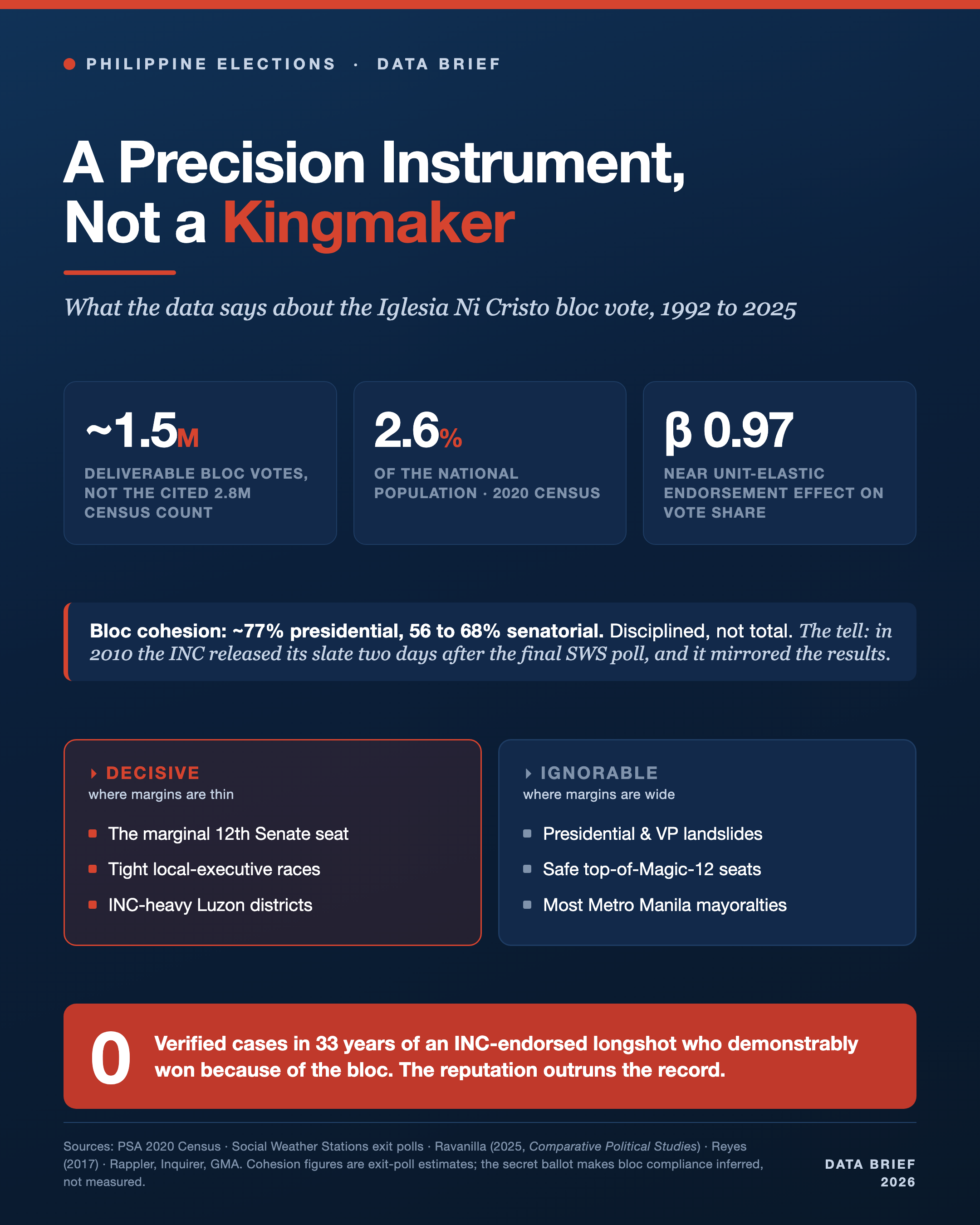
How much electoral influence the Iglesia Ni Cristo bloc vote actually holds in Philippine elections, and when it can be ignored. Post-EDSA record, 1992 to 2025.
This study assesses how much electoral influence the Iglesia Ni Cristo (INC) bloc vote actually holds in the Philippines, across the post-EDSA record from 1992 to 2025, and at four tiers: national executive, Senate, congressional districts, and local executives. It was produced through a two-pass deep-research harness with adversarial verification of extracted claims. The deference Philippine politicians show the INC turns out to be partially but not uniformly warranted: real and statistically demonstrable at the margins, but strongly tier-dependent and conditional on how close the race is, not a blanket national power.
1. The mechanism is strong. The best causal evidence (Ravanilla 2025, peer-reviewed, triple-difference design) finds a near unit-elastic link between a municipality's INC concentration and the vote share of INC-endorsed senators (β = 0.97), with essentially zero effect for non-endorsed candidates (β = 0.01). That is the statistical signature of a disciplined bloc.
2. The bloc is small in absolute terms. The 2020 census counts about 2.8M INC members (2.6% of the population), but the deliverable vote is smaller: SWS exit-poll data puts INC at roughly 4.25 to 5% of the electorate, about 1.5M votes. Cohesion runs about 75 to 80% in presidential races and 56 to 68% down-ballot.
3. A small but disciplined bloc only decides close races. INC can plausibly swing outcomes only where the margin is within roughly 1 to 1.5M votes: the marginal 12th Senate seat, congressional districts, and tight local-executive contests. In lopsided national races it is neither necessary nor sufficient. Layered on top is a strong reverse-causation problem (the INC tends to endorse poll-leading frontrunners; the 2010 slate was released two days after the final SWS survey and mirrored it). Across 33 years and all tiers, no single case was verified where an INC-endorsed longshot demonstrably won because of the bloc.
INC is a precision instrument, not a sledgehammer: decisive at the margin, marginal at the top. Deference is rational insurance in close down-ballot and local races, and largely overstated theater in national executive contests.